

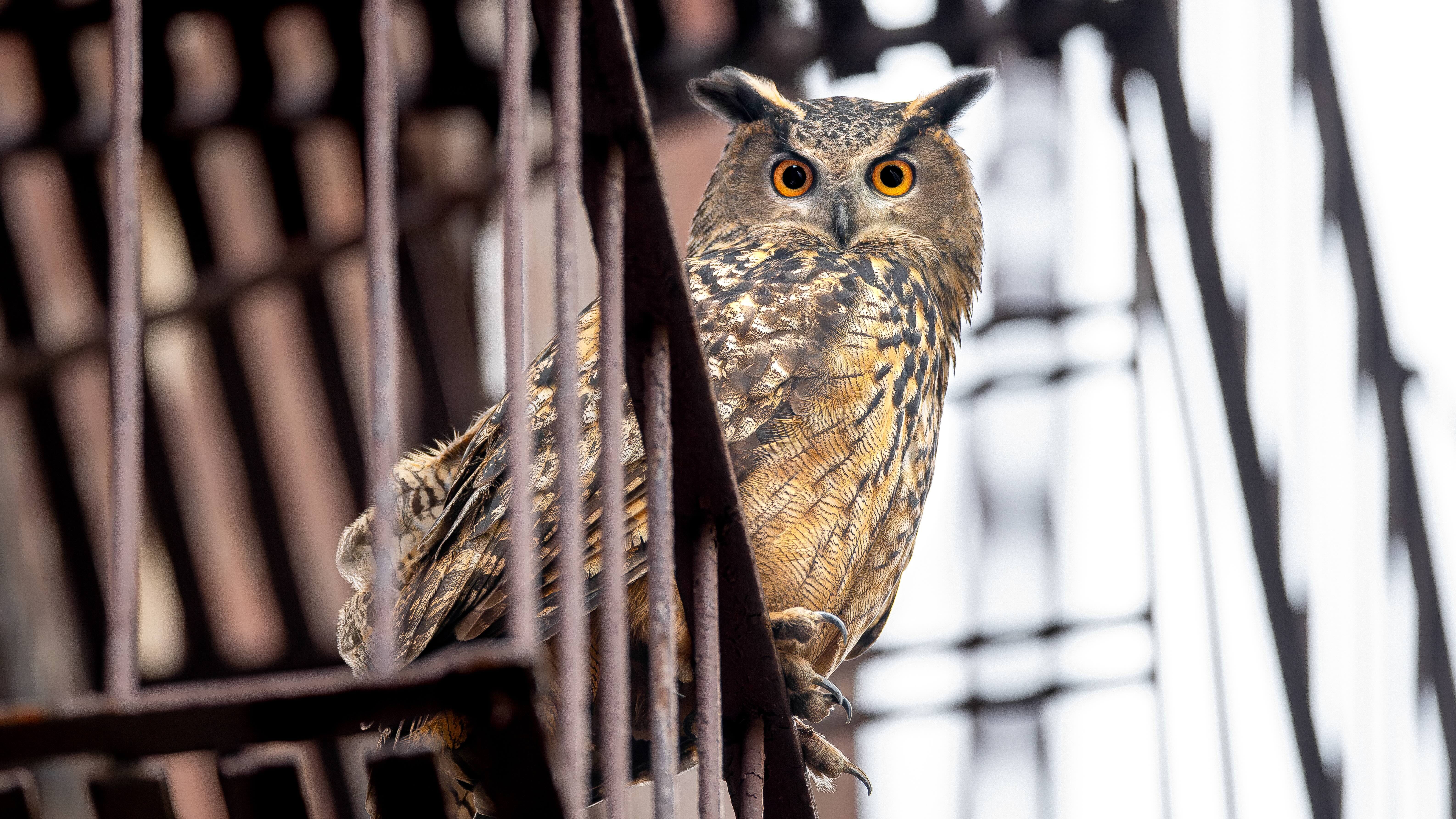
“I think there’s something very real about his story. He just said fuck it, and flew,” says a woman who has just gotten matching Flaco tattoos with her new husband in Penny Lane’s enthralling documentary Wild Inside. For those who weren’t among his legion of fans, Flaco was the magnificent owl with a six-foot wing span who escaped from Central Park Zoo on February 2, 2023, liberated by vandals from his cage after thirteen years of captivity. Flaco taught himself to hunt, learned to fend for himself, and explored the city, all while being obsessively followed by amateur photographers who posted images on Twitter (back when the app still had a bird-inspired name).
When the zoo made the decision not to retrieve Flaco after he flew the coop, and to let him try to fend for himself in the wilds of Gotham, Lane knew there was a story worth following. A brilliant documentarian with an owl’s proverbial curiosity, Lane’s wide-ranging movies are adventurous in form and subject, covering topics including satanism (Hail Satan), mysterious illnesses (The Pain of Others), and a goat testicle impotence cure (Nuts!). She has made balanced and nuanced portraits of Richard Nixon and Kenny G, and two short films about birds (with Jessica Bardsley) : The Commoners, about the rise of the European Starling in Central Park, and The Wren, about the connections between the winter wren bird and Emily Dickinson.
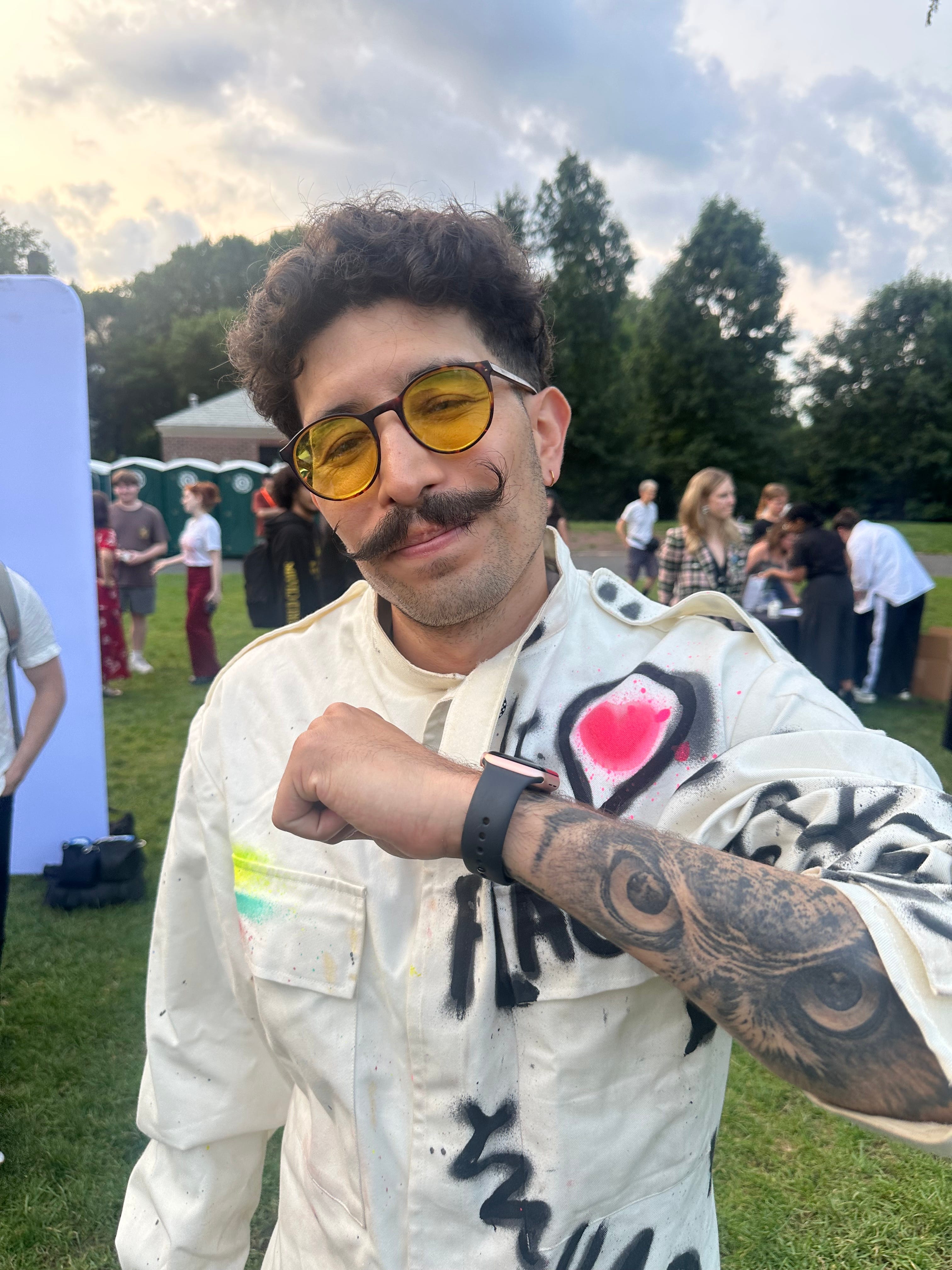
A portrait of a charismatic if at times inscrutable character, Wild Inside is also about animal rights, and a philosophical inquiry about our relationship to non-humans. And with its focus mainly on the countless enthusiasts around Flaco, and about the beautiful but harsh city he seemed to rule from his perch, Wild Inside is a great New York movie. Tenacious, confident, and cool, Flaco was a quintessential city striver. To the artist Calicho Arevalo, a Colombian-American who has painted at least three murals of Flaco, “I related to him, as an immigrant who came to New York and had to learn how to survive and make it into the city.”
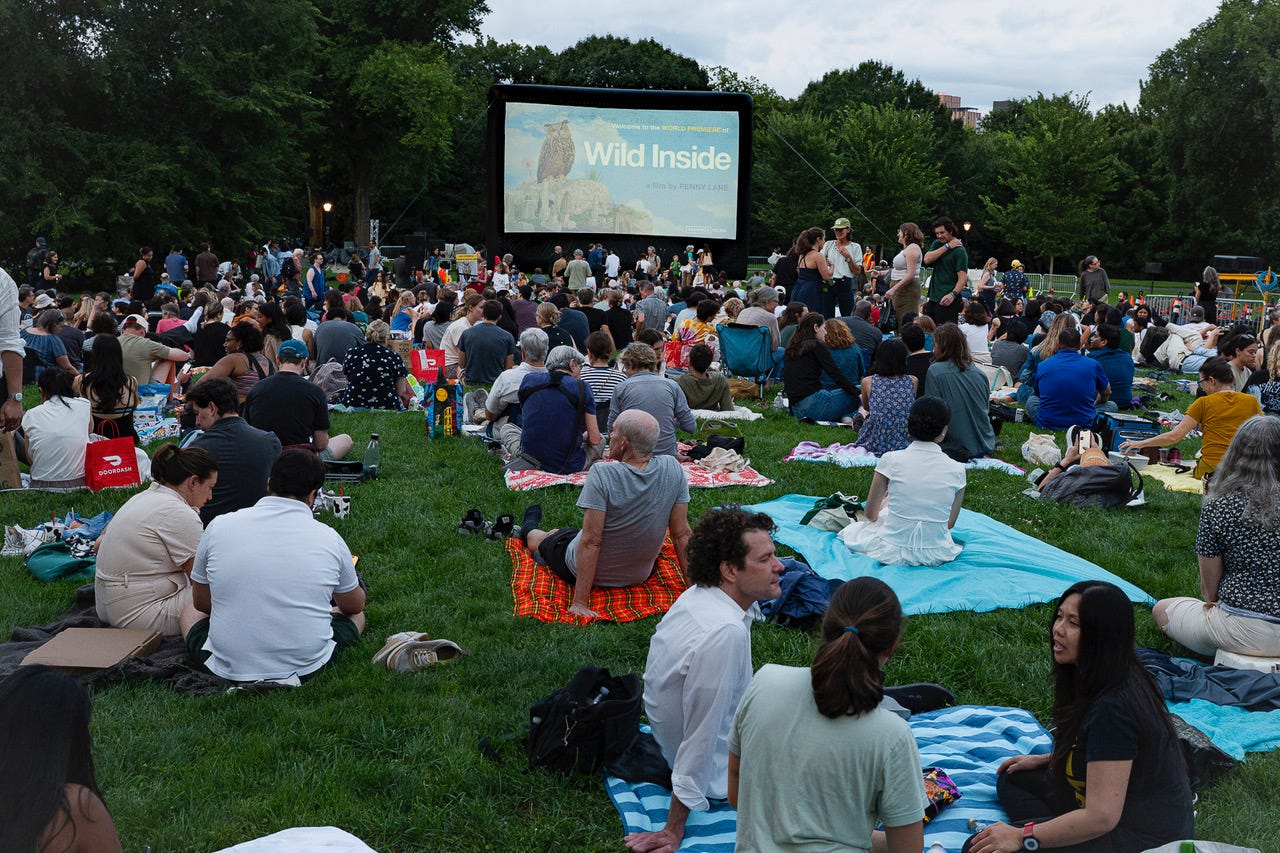
To make Wild Inside, Lane resourcefully crowd-sourced much of the imagery of Flaco, drawing on the treasure trove of video and still photography of him taken throughout his miraculous year of freedom. Flaco ventured outside of the park, spending his days flying around town, perching on air conditioners and peering into windows. A man who spotted him downtown said, “Maybe he’s looking for love in the East Village. We’re all looking for love in the East Village.” Flaco may not have found his mate, but captured the city’s heart. Tragically, but inevitably, he met his cruel but inevitable fate in February 2024, dying after he ate a rat that had ingested rodenticide. Was Flaco’s year of freedom worth the price he paid? Wild Inside doesn’t give a definitive answer. As in all of her best films, Lane takes us on an unforgettable journey, raising difficult and fascinating questions along the way. I talked to her a few days before the film’s premiere in Central Park (an event Flaco would have loved), and before it started playing to enthusiastic sold-out showings at the IFC Center.
When did you get interested in Flaco?
On that first night that you see in the film. My dear friend Jeremy Workman was the first voice in the film because he was the first person to see Flaco that we know of. He was in that neighborhood because he was at a memorial for Ed Pressman, the legendary producer.
Which I hosted at the Paris Theater, when I was managing the theater for Netflix.
You’re shitting me. You hosted it?
I put that event together, yeah.
That was the night that Flacco escaped. So Jeremy was there because he was at that event that you put together. He was going home. He turned the corner, and that’s when he ran into Flaco. And so he sent me pictures because he knew that I’m a bird person. He said “This is weird.” And I said, “Oh my God. That’s not a native owl. Why is it on the sidewalk? He needs help. He’s probably in trouble. So I was deeply, intimately involved from the minute the story began.
But I didn’t know that I’d make a film about it until maybe three or four weeks later. Certain things had to happen before I knew there’d be a story. To be frank, I thought he was going to die. So I’m not sure that would have turned into a movie. Or I thought the zoo was going to capture him and put him back in that cage, which also wouldn’t have been a very interesting movie. So it was only when the zoo decided they were going to stop trying to capture him, and that he proved that he could hunt for himself and take care of himself, that I thought this is going to be so amazing. My feeling was that whatever happens will be fascinating because it’s never happened before. And the complexity of that issue, should he be free or should he not? Watching those debates raging on what was then still Twitter. I’m a bird person and I probably always wanted to make a movie about birds on some level, but it was always so boring. Birding is not a cinematic activity. People have these binoculars in front of their face. It’s just not interesting to watch people go birding, but this was different.
It’s a great film on different levels. Flaco has so much personality. But it really becomes a movie about New York. First about Central Park, but then bigger than that.
Yeah, Central Park is this weird, sort of fake wilderness in the middle of Manhattan. But it provides a real habitat for real animals. Over 300 species of birds make their home in Central Park. Not to mention the coyotes and the foxes and the flying squirrels and the other animals that live in the park. So it’s about New York, but it’s also about New Yorkers and expanding beyond just the human animals to all the other animals that live here with us too.
Well one thing about living in New York, of course, is that you can be alone. And a lot of it’s about sort of being alone, but being part of a city. And that’s one of the things that’s so fascinating about Flaco is that he was just living his own life and being himself…
And unbeknownst to him, he was beloved by millions around the world. There is something funny about telling a story about an animal because the animal has absolutely no idea that you’re doing this and doesn’t know what that is and doesn’t know what his story is or a movie. So, yeah, he was just living his own life. He was writing his own story. That’s always how I thought of it. The minute that someone broke him out of that zoo and left him on that sidewalk, he started making choices for the first time in his life about what to do, where to go, what to eat, where to be, how to protect himself from the elements. He had no agency for thirteen years, and then suddenly he did. And that is the making of a great story, which classically has a protagonist–a charismatic, interesting protagonist we hope–who is on a journey, whose goals are evident, you know, and Flaco’s goals were evident from the minute he began. He wanted to survive. Be comfortable in the rain. He wanted to get out of the way of fireworks. And then eventually he wanted to mate, which was tragic because we knew he never would because there’s no one for him here. But he wanted what everyone wants in life. And it was just very easy to root for him on his quest–his odyssey, if you will.
And it’s a flaneur’s life, whatever the bird equivalent of a flaneur is. Not to anthropomorphize him He does seem very curious in the part of the film when he’s peeping into windows.
I don’t think you have to anthropomorphize though to say he’s curious. I mean, humans are animals, and other animals are animals too. We all possess basic life drives, life urges that are part of our makeup. We are all on a quest; you’re on a quest to live your life, I’m on a quest to live my life. And I don’t think it’s anthropomorphic to say that an animal is on a quest to kind of make the most of their own life too. Flaco had a six-foot wingspan? What is that for, if not to fly? Can you imagine having a six foot wingspan and for thirteen years never being able to fly? Doesn’t that seem like a basic injustice? Even if you’re not a scientist or an expert.
I assume most people come away from the film feeling that despite the fact that he might have had a shorter life after he escaped, this is the life he was meant to have.
I don’t know if everyone will walk away from the film feeling that way. I think a lot of people think the fact that he died the way he died was proof that he never should have been free. And frankly, I don’t think he should. No one should have let him loose in Manhattan like that, and whatever that person had in mind was pretty stupid. The most likely outcome of that was that he was going to die immediately. That’s what I thought. Because that’s what happens when animals get out of the zoo. They panic. They run around. They get hit by buses. I mean, he was in midtown Manhattan.
So would the alternative have been to take him somewhere else?
Yeah, but that was like a fantasy. A Twitter fantasy. People said the zoo should capture him and put him in a beautiful sanctuary. But that would require the zoo to acknowledge that their conditions were substandard to begin with. And if there’s one thing I’ve learned of the Central Park Zoo, it’s that they are not going to acknowledge anything about their conditions being anything less than perfect. Trust me, I tried many times to get a comment from them. It was a huge mistake on their part to not participate because my goal was to be show the people who love Flaco and care about him. And I’d like to show how much this was probably ripping them apart. Because it probably did. I mean, can you imagine if you were responsible? They were responsible for this owl. The whole reason he was in Manhattan was them. They put him there. Of course they weren’t responsible for him being broken out. That was a criminal. But once that happened they were still responsible for his well-being. Bruce Yolton, one of the birders in the film, says that after two weeks they abdicated their responsibility for him. How dare they? So ultimately there are a lot of human beings at every point in the story who are to blame for everything that went wrong for Flaco. Flaco wasn’t to blame for any of it. He was just being an owl and doing the best he could with the life he was given. But yeah, New York’s a tough place for birds. And he didn’t ask to be here. Neither did, by the way, the Norway brown rats that we also brought here. And now we’re poisoning and killing all of the native ecosystem. I mean, all these animals are just animals. They’re so blameless. The only villain in the story is humanity.
Exactly. To get back to the idea of the film being a portrait of the city and its subcultures, could you talk about your interaction with the Flaco watchers. It was a surprisingly large group.
It’s a very large group. I tried to get at least a couple shots of everyone that I met, even though I wasn’t able to include everyone because there were so many in this core group of people that were his paparazzi. It was really fun. I mean, I know birders pretty well because I’ve been a birder for most of my life. But owlers are a particular breed because they go out at night and are even more quiet and secretive. They’re out in the middle of the night when you can’t imagine anyone’s doing anything, but they’re getting their best shots at 3:00 a.m. It’s pretty wild to be out in Central Park at three in the morning. We left this out of the film, but I asked them if they were afraid to be out alone in the middle of the night. So they’re kind of brave. But they all posted when they were out.
I was going to ask you how you found these people.
They were all posting. So that was how I knew that there was a film that could be made, because of this dedicated group of paparazzi–ethical paparazzi because they’re birders and they were respectful and they always stayed far away from Flaco and use really long lenses. You think that they’re right there on top of him, but they have really nice specialized gear. Any birder would not go close to a bird. Anyway I knew that he had this, like, that he would be the most documented owl in human history. I mean, he kind of already was after only two to three weeks of him being loose. And I knew that wasn’t going to stop. People are going to continue to be fascinated by this. And people are going to continue to create these high quality photos and videos. So if I cooperate with this community, I can crowd-source this film. I mean, you don’t know when you’re watching the film just how little footage is from my crew that I paid. I feel like that makes up for just five or six shots. It’s very difficult to get good nature photography, as you probably know. Nature photography is its own beast. You have to kind of go out there and wait, wait, wait, wait. And I can’t pay my full film crew to do that. So it was really essential that the film be crowdsourced because it’s beyond anything I could do with my limited hours in the day and my limited dollars. So it was about getting to know that community and gaining trust in that community and, you know, cooperating with them and working with them to create the film.
I figured there must be a lot of…
…they call it user-generated content. But it’s so high quality that you think it’s mine because it looks so professional. Right. But that’s just because there’s so many “amateur” photographers in New York that are really good.
One of the great things when the Knicks won the championship was seeing all of the great fan footage of the celebrations.
Yeah. I love that a lot of people are making a comparison between Flaco’s Freedom and the Knicks. It’s like these moments that bring New York together.
Look forward to your substack !